Rethinking management education in the age of artificial intelligence
Since the emergence of the first business schools in the 20th century, management education has evolved in response to economic, technological, and social transformations, helping to redefine organizational models and leadership practices in contemporary capitalism. The intensifying impact of digital technologies, and the advent of artificial intelligence in particular (Dagnino and Tirabeni, 2025), could mark a new evolutionary phase in the history of business schools. Indeed, this moment may be comparable to the major transformations that accompanied the birth of the modern MBA and the emergence of a scientific approach to the study of management (Csaszar, Jacobides, and Zemsky, 2025). Tools based on machine learning and generative AI (GenAI) are now capable of analyzing vast amounts of data, producing complex outputs, and intervening in decision-making processes at extremely rapid speeds. In many cases, these systems can replicate or even surpass some of the analytical capabilities traditionally taught in management education programs, raising questions about the role and value of management training.
AI and the paradox of management education
By incorporating advanced digital technologies in educational programs, business schools are contributing to the spread of more flexible, personalized, and experience-oriented educational models, in line with the principles of what is being called Education 4.0 (Jain et al., 2025). Adaptive learning tools, digital simulations, and online collaborative environments are transforming the educational experience, offering novel opportunities but also introducing new pedagogical and organizational challenges. Recent surveys (AACSB, 2025; Brady et al., 2025) indicate that AI is now widely adopted in management education programs. In fact, approximately 74% of business schools globally report teaching GenAI through dedicated courses or modules included in existing programs, while nearly 80% use AI technologies in teaching or learning activities. As for faculty, around 64% use GenAI tools in teaching activities, and over 78% encourage students to utilize these technologies for brainstorming. However, at an institutional level, AI integration is still limited as only 47% of business schools have formal policies on the use of AI, and just 12% require specific training for faculty.
Overall, these data indicate a rapidly accelerating phase of experimentation, in which the dissemination of technologies is outpacing the establishment of adequate governance structures and educational strategies. The growing use of AI in decision-making processes also raises serious questions regarding the development of critical thinking and judgment skills. While such systems can facilitate access to information and broaden students’ analytical perspectives, passive use can lower cognitive engagement and the capacity for independent thinking. Recent studies show, in fact, that when people interact with GenAI systems, they may have a greater tendency to accept algorithm-generated answers, spending less time verifying sources or conducting independent analysis (Larson et al., 2024).
A new cognitive technology
The emergence of GenAI in the world of management education marks a paradigm shift that goes beyond embracing new educational technology. Unlike previous waves of digitalization, from e-learning platforms to learning management systems, GenAI does not merely facilitate access to knowledge or upgrade the efficiency of educational processes. It directly influences the cognitive activities that form the core of management training, such as analyzing problems, synthesizing information, and structuring arguments. In this sense, we can consider GenAI a true cognitive technology, capable of complementing—and in some cases replacing—analytical skills traditionally taught in management programs. Tools such as ChatGPT and other advanced language models are now capable of generating strategic reports, market analyses, marketing plans, and business plans in a matter of seconds, instantly leveraging skills that until recently required years of training and professional practice to acquire. So it is not surprising that numerous studies underscore that AI is redefining the relationship between knowledge, learning, and competence in business schools (Xu, 2021; Ratten and Jones, 2023).
The risk of cognitive delegation
What added value can management education offer, then, if many of the analytical skills taught in management courses can be replicated—or even surpassed—by algorithmic systems? This issue predates the current GenAI boom. In fact, several studies have already revealed a growing gap between the skills taught in business schools and the emerging needs of organizations (Sollosy and McInerney, 2022). The advent of GenAI models makes this gap even more evident today, as it automates precisely those cognitive processes that form the basis of traditional educational activities, such as information search, synthesis, analytical writing, and so forth.
The spread of these tools introduces an educational paradox: Technologies that can enrich the learning experience simultaneously risk weakening the cognitive processes that higher education is meant to cultivate. Recent evidence shows that the extensive use of GenAI tools can foster forms of cognitive delegation, in which students entrust algorithms with activities like analyzing and processing data, and formulating arguments, tasks which previously they would have done themselves through direct engagement (Valcea et al., 2024). In light of this, some authors are talking about a potential risk of cognitive deskilling. In other words, the unreflective use of AI diminishes the depth of learning and escalates technological dependence (Ivanov, 2023; Izak et al., 2025). And the problem isn’t just the quality of the work that students produce, but also how they build and internalize knowledge. If AI instantly offers summaries and ready-made solutions, learning risks being progressively downgraded from a process of active knowledge construction to an activity of selecting and reviewing algorithmic outputs.
From problem solving to making strategic judgments
An exclusively pessimistic view of the impact of GenAI risks overlooking the opportunities these technologies offer for reconceiving managerial training. Recent studies highlight how AI-based tools can support new forms of experiential learning, facilitate the exploration of complex scenarios, and stimulate creative processes through human-machine dialogue (Guha et al., 2023; Vecchiarini and Somià, 2023). In innovative entrepreneurial contexts, for example, GenAI systems can help people come up with ideas, assess market opportunities, and simulate strategic decisions, acting not as substitutes for managerial skills but as cognitive amplifiers. The most effective results in these cases emerge by combining algorithmic analysis, contextual knowledge, and human experience (Cristofaro and Giardino, 2025; Cristofaro et al., 2026).
But the issue is not only about integrating GenAI into curricula in technical terms, but also redefining the competencies that should be the focus of management education. With the progressive automation of analytical activities, the distinctive value of managerial training is veering toward capabilities that are difficult for algorithms to replicate, such as making strategic judgments, interpreting complex contexts, managing ambiguities, and taking on leadership roles in socio-technical systems. In other words, the spread of AI does not diminish the relevance of business schools, but profoundly transforms their mission. Rather than merely imparting knowledge and analytical tools, that mission is now to train professionals capable of collaborating with intelligent systems, critically interpreting their results, and exploiting their potential in organizational decision-making processes. It is precisely this tension between cognitive automation and human judgment that constitutes one of the central issues in the contemporary debate on the future of business schools.
A framework for rethinking management education
In this context of rapid and often chaotic transformation, there is an ever greater need to guide the integration of AI into management education through thoughtful, systematic approaches. With this goal in mind, the Education Committee of the International Federation of Scholarly Associations of Management (IFSAM) has compiled the Vademecum on Generative AI in Management Education.[1] The document does not merely offer operational recommendations on the use of GenAI in educational contexts, but proposes a broader conceptual framework to help business schools redesign their teaching practices, governance models, and the competencies they aim to develop in future managers.
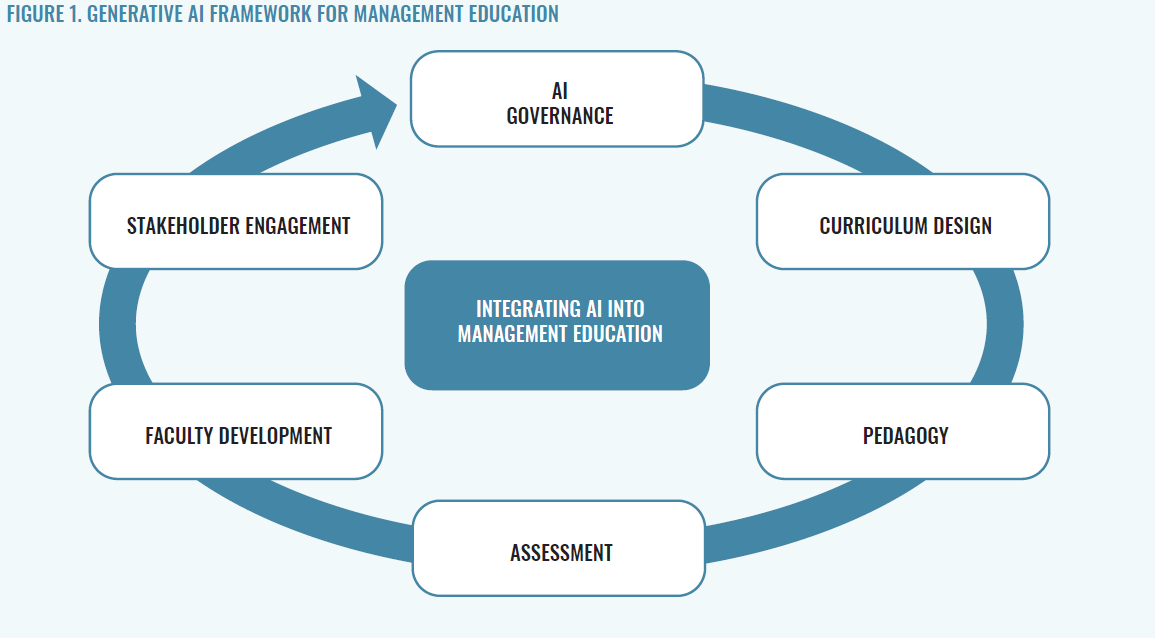
The initial premise is that AI integration cannot be addressed exclusively as a technological issue. On the contrary, this process requires a cultural, pedagogical, and ethical realignment of educational institutions, with an eye to balancing innovation and responsibility. From this perspective, the Vademecum sets down a series of guiding principles to assist business schools in adopting these technologies: academic integrity, transparency, AI literacy, inclusion, and institutional reflexivity. Specifically, IFSAM introduces the Generative AI Framework for Management Education (GIFME), a model designed to support educational institutions in incorporating GenAI into management programs in a coherent and responsible manner. Rather than a set of rigid prescriptions, GIFME represents a dynamic, circular system, designed to foster institutional learning and continuous adaptation. The framework is structured into six interdependent domains, reflecting the key dimensions through which AI can influence management education.
Govern before being governed
The first domain revolves around institutional governance. Before introducing GenAI in business schools, clear policies must be put in place that set the ethical and operational boundaries of its use. Several universities have already drawn up AI charters or institutional standards on generative tools in academic work, establishing parameters for disclosure regarding when and how researchers utilize these technologies. A recent study cited in the Vademecum points out that many US universities have published AI guidance documents, often accompanied by examples of teaching activities or recommendations for faculty. The goal of these initiatives is not to prohibit the use of AI, but to create conditions of transparency and accountability. In this sense, governance becomes the starting point for building institutional legitimacy and trust among students, faculty, and stakeholders.
A new language of management
The second area concerns redesigning curricula. According to the Vademecum, GenAI should not be treated as a specialized skill confined to a few technical courses; it should be embedded in the very core of management education. This implies reconsidering the approach to teaching traditional disciplines such as strategy, marketing, finance, or entrepreneurship, incorporating activities in which students use AI to analyze competitive scenarios, generate business ideas, and simulate managerial decisions. A prime example involves certain business schools that have transformed case-based courses by introducing living cases—dynamic scenarios in which AI generates changes in the business conditions in response to students’ decisions. In these contexts, AI becomes an integral part of the analytical language of management, allowing students to grapple with more complex, realistic decision-making settings.
Rethinking management pedagogy
The third domain relates to pedagogical practices. GenAI allows us to reflect on the dynamics of learning, transforming the relationship between students, teachers, and knowledge. Some universities are experimenting with teaching activities in which AI acts as a critical interlocutor. An example cited in the Vademecum describes a strategy course in which students present a proposal and then use a chatbot to generate counterarguments or critiques of their own analysis. In this way, dialogue with the generative system becomes a tool for strengthening reasoning and identifying weaknesses in the proposed strategies. In this way, AI does not replace students’ work but acts as a sort of digital devil’s advocate, stimulating critical discussion and reflection.
What remains to be evaluated?
The spread of GenAI has highlighted the need to revise how learning is assessed. Written assignments such as essays or reports can now be easily generated by AI systems, challenging traditional assessment methods. The Vademecum describes various innovations introduced by business schools to address this challenge. In some courses, for example, students must attach an AI log* *to their work: a record of their interactions with the AI that documents the prompts they used, the responses they discarded, and their process for constructing the output. In other cases, institutions are reintroducing oral discussions or in-person exams, in which students must explain and defend their reasoning. These practices turn the focus from the output to the reasoning process, and students must show how they use and interpret AI tools.
Rethinking the role of the teacher
Incorporating GenAI into teaching clearly means redefining the role of the teacher. In fact, the Vademecum emphasizes that faculty should not merely use new technological tools; they should act as facilitators of learning processes in which students and AI interact in a reflective manner. To support this change, some universities have introduced AI sandboxes, experimental spaces that allow faculty to test new tools and share teaching experiences. In other cases, institutions have created interdisciplinary training programs or micro-credential tracks in AI literacy, aimed at both students and faculty.
Business schools are not alone
The GIFME framework also emphasizes the importance of stakeholder engagement. The assimilation of AI into management education does not concern only universities and faculty, but also involves businesses, students, professional associations, and accrediting bodies. Some business schools have already established multi-stakeholder advisory panels that include students, managers, and alumni to discuss the use of AI in educational programs. At the same time, more than ever before, companies are recruiting graduates who are not only capable of using AI tools, but who also understand their ethical and strategic implications. This interaction between universities and the professional world helps keep management education aligned with changes in the workplace.
A framework, not a foolproof formula
A distinctive feature of the GIFME framework is its circular nature. The six domains do not represent linear phases, but rather interconnected components of an institutional learning system. Governance, curriculum, pedagogy, assessment, faculty development, and stakeholder engagement influence one another, generating a continuous process of experimentation and adaptation. From this perspective, the Vademecum does not propose a definitive solution for integrating AI into management education. Rather, it invites the leaders of business schools to view AI as a catalyst for reconsidering their educational role, training managers capable of combining technological skills, critical judgment, and ethical responsibility.
Conclusions and managerial implications
GenAI is ushering in a new era in management education. In just a few years, tools capable of producing analyses, strategic reports, marketing plans, or complex summaries have become accessible to millions of students and professionals, a phenomenon which is calling into question the very mission of business schools. For over a century, these institutions have built their identity on the transmission of knowledge and analytical tools. Today, more and more of these activities can be performed by intelligent systems, or so it would seem. When an algorithm can devise a strategy or synthesize vast amounts of information in seconds, the question is no longer what to teach, but what distinctive value to offer. The difference lies not in the speed of technology adoption, but in how these technologies are interpreted and integrated into decision-making processes.
Organizations will continue to need leaders capable of asking relevant questions, assessing ethical implications, and making decisions under conditions of uncertainty. Critical thinking, the ability to envision alternative scenarios, human understanding of complex contexts: all these are still difficult to automate. The spread of GenAI therefore represents an opportunity to redefine the mission of business schools. Rather than merely offering models and tools, the focus should turn to developing the ability to interact with intelligent systems, to critically evaluate their results, and to use this output thoughtfully. In this way, management education would become a space for experimenting, for exploring new forms of collaboration between human and artificial intelligence.
The Vademecum and the GIFME framework proposed by the IFSAM Education Committee represent the first step in this direction, encouraging business schools to experiment and adapt in a rapidly changing context. Looking ahead, the challenge will be to maintain a balance between exploiting technology while prioritizing the human experience. Ultimately, the task of management education is not to teach students to compete with machines, but to train managers to collaborate with AI without sacrificing their own judgment. Even in a context increasingly driven by algorithms, the quality of decisions will continue to depend on the quality of human thought.
Managerial Impact Factors
- GenAI is redefining the role of business schools, shifting the value of managerial education from transmitting analytical knowledge to developing critical judgment and decision-making responsibility.
- The integration of AI into management programs cannot be limited to the introduction of new digital tools, but requires a coordinated redesign of governance, curricula, pedagogy, and assessment systems.
- Business schools must prepare managers who are capable of collaborating with intelligent systems, critically interpreting their outputs, and embedding them in decision-making processes without delegating their own judgment.
- The main risk is not the use of AI, but this cognitive delegation. Therefore, reasoning processes must be visible and assessable in management training, not just the final outputs.
- Frameworks such as GIFME can help educational institutions systematically adopt GenAI, transforming a technological disruption into an opportunity for pedagogical and institutional innovation.
References
- AACSB (2025). GenAI Adoption in Business Schools: Deans and Faculty Respond.
- Brady, M., Fellenz, M., Lefevre, D. (2025). “Walking the Tightrope: Why MBA Directors are Challenged with AI Adoption in MBA Education Change.” Global Focus. The EFMD Business Magazine.
- Cristofaro, M., Giardino, P.L. (2025). “Human–AI synergy: Finding cognitive balance in idea generation for product innovation.” European Journal of Innovation Management. DOI: 10.1108/EJIM-03-2025-0312.
- Cristofaro, M., Giardino, P.L., Muldoon, J. (2026). “Entrepreneurial decision-making in the age of AI: Sector knowledge at the balance of intuition and analysis.” Technology in Society, 85, 103200.
- Csaszar, F.A., Jacobides, M.G., Zemsky, P. (2025). “The effects of artificial intelligence on management education.” Strategic Organization, 14761270251385484.
- Dagnino, G.B., Tirabeni, L. (2025). “Formare i manager nell’era dell’AI: nuovi bisogni e paradigmi educativi.” Economia & Management, 2, 67–74.
- Guha, A., Grewal, D., Atlas, S. (2023). “Generative AI and marketing education: What the future holds.” Journal of Marketing Education, 46(1), 6–17.
- IFSAM Education Committee (2026). Vademecum on Generative AI in Management Education. International Federation of Scholarly Associations of Management.
- Ivanov, S. (2023). “The dark side of artificial intelligence in higher education.” The Service Industries Journal, 43(15–16), 1055–1082.
- Izak, M., et al. (2025). “Generative artificial intelligence and learning: At the dawn of idiocracy?” Management Learning, 56(3), 407–415.
- Jain, A., et al. (2025). “Reimagining management education: Navigating the shift to education 4.0 in the digital era.” The International Journal of Management Education, 23(2), 101182.
- Larson, B.Z., et al. (2024). “Critical thinking in the age of generative AI.” Academy of Management Learning & Education, 23(3), 373–378.
- Ratten, V., Jones, P. (2023). “Generative artificial intelligence (ChatGPT): Implications for management educators.” The International Journal of Management Education, 21(3), 100857.
- Sollosy, M., McInerney, M. (2022). “Artificial intelligence and business education: What should be taught.” The International Journal of Management Education, 20(3), 100720.
- Valcea, S., Hamdani, M.R., Wang, S. (2024). “Exploring the impact of ChatGPT on business school education: Prospects, boundaries, and paradoxes.” Journal of Management Education, 48(5), 915–947.
- Vecchiarini, M., Somià, T. (2023). “Redefining entrepreneurship education in the age of artificial intelligence.” The International Journal of Management Education, 21(3), 100879.
- Xu, J.J., Babaian, T. (2021). “Artificial intelligence in business curriculum: The pedagogy and learning outcomes.” The International Journal of Management Education, 19(3), 100550.