Trust, the hidden architecture of the economy
In an era marked by growing geopolitical instability, accelerated technological transformation, and economic volatility, it is not surprising that the word “trust” was one of the most discussed terms of 2025. When Italy’s most authoritative encyclopedia—Treccani—named it Word of the Year, the choice was less symbolic than it might have seemed. Indeed, today trust is one of the most telling indicators of the health of contemporary societies and economies. It is not merely a psychological or moral disposition, but a true relational infrastructure underpinning markets, institutions, businesses, organizations, and civil societies.
For some time, economic and managerial literature has underscored the fact that trust is critical to the functioning of social systems. Francis Fukuyama (1995) defined it as “the lubricant of cooperation,” while Niklas Luhmann (1979) interpreted it as a mechanism for reducing complexity, arguing that without trust, every decision would require levels of control, verification, and protection that would be difficult to sustain. Moreover, trust lowers transaction costs, facilitates exchanges, makes cooperation possible, and allows us to navigate contexts characterized by uncertainty. All in all, when people and organizations trust one another, agreements are formed more quickly and economic functioning becomes less burdensome.
It is from this perspective that the crucial role of trust in markets, consumer relationships, and brand systems should be understood. In other words, trust is not a simple social category; it is a strategic factor in the actions of businesses and institutions.
Trust as a social and economic binding force
Trust often operates invisibly, yet it profoundly influences the daily processes of society and the economy. Most of our economic actions, in fact, rest on assumptions about the future behavior of the other party: we purchase goods trusting in their quality, we use financial instruments believing in the soundness of the institution that offers and guarantees them, and we entrust personal information to digital platforms assuming that our data will be protected and used correctly.
From this perspective, trust functions as a forward-looking mechanism, enabling us to make choices in the present based on sufficiently stable future expectations. Without trust, suspicion, defensiveness, and decision-making paralysis prevail; society then tends to become rigid and markets slow down. This dynamic is particularly pronounced during times of financial crisis, political instability, or high inflation, when consumers tend to reduce purchases, businesses postpone investments, and organizations adopt more cautious behaviors.
It’s not simply a matter of financial resources; it’s also about expectations regarding the future. In this regard, Keynes (1936) spoke of animal spirits to describe the impulse to act that sustains consumption and investment even when available data do not permit a fully rational calculation. When this impulse weakens, we start behaving with more caution, we delay decision-making, and we are less inclined to take risks.
The relationship between trust and economic development appears even more evident today in a context marked by hyperconnectivity and the acceleration of information. In the brick-and-mortar economy, trust was often built through physical proximity, local reputation, and the continuity of relationships. Today, trust forms in much broader and more exposed environments, where digital media and social platforms make behaviors immediately visible and assessable. The reputation of a company, a brand, or an institution—even when it has taken years to establish—can evaporate in an instant.
From reputation to trust capital
In light of all this, trust is clearly taking on the attributes of a strategic asset. It is no longer merely an ethical or reputational value, but a concrete, measurable economic resource directly linked to competitive performance.
Generally speaking, a customer who trusts a company or brand repurchases more consistently, shows less price sensitivity, and recommends products and suppliers more readily. As the cover feature in this issue demonstrates, trust fosters customer loyalty and strengthens the resilience of the relationship even during difficult times. In managerial terms, this translates into lower acquisition costs, greater revenue stability, and higher relational value over time.
It is no coincidence that in recent years, many studies and numerous companies have begun to view trustworthiness as a crucial dimension of brand equity. Alongside traditional indicators of brand awareness and satisfaction, in fact, there is growing attention toward metrics that measure perceived reliability, consistency, transparency, and credibility.
Trust, however, has a unique feature: it is cumulative, yet fragile. It is built slowly but can erode rapidly. For this reason, in today’s increasingly digital and fluid context, organizations are called upon to exercise greater consistency than in the past. Communication alone is no longer enough. In an ecosystem characterized by hypervisibility and widespread scrutiny, trust depends above all on the alignment between promises and behaviors. Consumers, employees, and stakeholders evaluate companies based on their ability to consistently deliver on their claims over time: sustainability, inclusion, quality, transparency, and social responsibility.
From this perspective, trust is perhaps the primary litmus test of today’s economy. In a market saturated with messages, what truly sets organizations apart is not just what they claim, but the credibility of their actions.
Trust as the “shadow of the future”
One of the most intriguing concepts proposed by Axelrod (1984) defines trust as “the shadow of the future cast upon the present.” This formulation implicitly echoes Luhmann’s (1979) sociological reflection and effectively captures the temporal nature of trust. To trust, in fact, means to anticipate the future: to imagine that a promise will be kept, that a service will be provided properly, that a relationship will endure.
Much of economic activity operates precisely on this temporal projection. When we buy a plane ticket, take out an insurance policy, or entrust our savings to a financial institution, we are performing an act of trust: we assume that the system will deliver on its promises.
In times of great uncertainty, however, this capacity for anticipation tends to wane. Geopolitical instability, market volatility, the transformations driven by artificial intelligence, and the proliferating perception of unpredictability all make it harder to imagine the future as a reliable space. And this is precisely where a crucial issue for contemporary management arises.
Companies cannot limit themselves to managing operational efficiency; they must become producers of trust. That is, they must offer continuity, clarity, and reliability in an environment people perceive as unstable. This implies a profound rethinking of leadership, communication, and organizational culture.
Back to the basics of trust
What, then, will serve as our compass for the coming years? The answer is, in some ways, surprisingly simple: building trust means keeping promises over time.
In an era dominated by accelerated innovation, disintermediation, and the constant pursuit of novelty, going back to the basics may seem almost counterintuitive. Yet it is precisely this simplicity that contains a fundamental strategic insight. Trust, in fact, arises from the consistent alignment of statements and actions.
According to management literature, there are three main drivers of trust: competence, integrity, and benevolence (Mayer, Davis, and Schoorman, 1995). An entity (whether that be an individual, a company, or an institution) is perceived as trustworthy when it demonstrates competence, avoids acting opportunistically, and considers the interests of other parties with whom it interacts. These are seemingly traditional dimensions, but today they are more decisive than ever.
In this sense, the real challenge concerns not only the ability to innovate, but also the capacity to be credible. And credibility cannot be built solely through reputational tools. Instead, it requires consistent behavior, transparent governance, and leadership capable of generating relational security.
This issue affects businesses, but more broadly it concerns the quality of social and institutional systems. Where trust weakens, the cost of cooperation rises; where mistrust prevails, conflict, fragmentation, and defensive isolation escalate. Conversely, societies with high levels of trust tend to produce greater innovation, stronger economic development, and more stable social relationships.
Trust, therefore, is not an incidental element of economic functioning. It is the invisible prerequisite. For this reason, in a time marked by uncertainty, trust is once again at the heart of public and managerial debate. To speak of trust means, ultimately, to question the very possibility of imagining the future as a space to build collectively, through relationships, institutions, and markets that endure over time.
References
- Axelrod, R. (1984). The Evolution of Cooperation. Basic Books.
- Fukuyama, F. (1995). Trust: The Social Virtues and the Creation of Prosperity. Free Press.
- Keynes, J.M. (1936). The General Theory of Employment, Interest, and Money. Palgrave Macmillan.
- Luhmann, N. (1979). Trust and Power (T. Burns & G. Poggi, trans.). John Wiley & Sons.
- Mayer, R.C., Davis, J.H., Schoorman, F.D. (1995). “An integrative model of organizational trust.” Academy of Management Review, 20(3), 709–734.
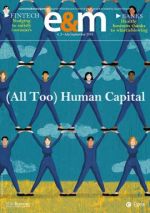
Photo iStock / Ben Slater