Search
Applied filters:
Refine search
- Keyword
- tipocontenuto_006 (10)
- Italy (8)
- Capitalism (7)
- State (7)
- Africa (6)
- Economy (6)
- Aging (4)
- Business (4)
- Subject
- Accounting & control (4)
- Politics (1)
- Knowledge area
- Political economy (27)
- Economic history (8)
- Microeconomics (7)
- International economics (6)
- Macroeconomics (4)
- Demography (2)
- Labor economics (2)
- Public finance (2)
- Content type
- Journal article (39)
- Editorial & column (6)
- Case history (1)
- Dossier and report (1)
- Interview (1)
- Continent
- Europe (12)
- Asia (1)

Ten Years of Changes in the World of Work
In the last decade the Italian labor market has gone through substantial transformations, from the structure of employment, to the professional composition of the population, to the living conditions of workers, have been determined by the intersection of cyclical and structural factors: the great economic crisis, the gradual shift of production towards services, and long-term socio-demographic trends. In ...
The Good and the Bad of the Gig Economy
Technological innovation is producing epochal transformations in the economy, not only making heretofore unthinkable organizational scenarios possible, but increasingly affecting society, conditioning the way people work and consume. The evident aspect of these transformations is the rapid multiplication of commonly used terms – such as gig , sharing , or platform – that have enriched the vocabulary ...
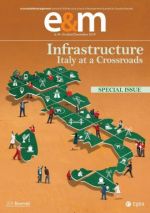
Development and Wellbeing A Question of Works
The economic development and fortunes of States over the centuries have been sustained and often conditioned by the construction of infrastructure. This has allowed many backwards and economically depressed regions to reach excellent levels of prosperity. In addition, the system of infrastructure has had, and still has, an evident geopolitical impact. In that regard, the Treaty of Rome of 1957 expressly ...
TAP: a Priority for Europe. And for Italy?
The TAP (Trans Adriatic Pipeline) is one of the so-called PCIs, the projects considered as priority for the European Union’s energy policy. As it crosses through Italy to reach the markets of Northern Europe, our country should benefit from a whole series of indirect advantages deriving from this infrastructure.#These are linked mainly to the certainty of supplies and the geopolitical and strategic ...
TAV: the Project that Doesn’t Exist
The high-speed rail line is not the first major project concerning the Val Susa area: there was the “ecological highway,” then the power line, and now the high-speed train line (TAV). Initially, the opposition led by the Habitat Committee against a “conception of the territory as a passive resource” was low-key, but it served to arouse the population.#The No TAV message is clear and summed ...
New Mobility for the Country
From 2002 to date, 60 percent of state funding has gone to investments in roads and highways. Yet 42 percent of the national population lives in urban areas, where there is the largest infrastructure gap with respect to the rest of Europe, and above all, where we find most of the demand for transport. To deal with that demand, there should be an increase in the number of trains in circulation, starting ...

The Long Autumn in Italy’s History
In the 1970s, Italy lived through an unprecedented cycle of labor conflict, that started with the Fiat strike in September 1969, and ended with the “March of 40,000” in Turin in October 1980.#The dynamics of industrial relations in Italy had previously seen moments of particularly strong conflict which had been followed by a retreat of the unions: the occupation of the Red Biennial (1919-1920), ...
A Synergy of Public and Private in Space Exploration
The first phase in the history of human exploration of space, in the 1950s and ’60s, saw a pre-eminent role of government: public investment in the military field and the missions to the moon set off processes of technological innovation with very positive spinoffs for the economies as a whole, as in the case of the development of satellite technologies,#Since the 1970s, more and more private corporations ...
What Future for Italian Ports
Given our country’s geographical structure and history, it is not surprising that the Italian port system features a wide variety in terms of infrastructure, volumes, commercial activities, efficiency, and development. However, since the 1980s the absence of a view to development of the ports, which is instrumental to the development of the country, has limited its prospects for growth, relegating ...
The Macroeconomic Context: Strengths and Weaknesses
The decision of whether or not to invest significance public resources for the development of transport infrastructure has been, and is, at the center of public debate in Italy. On the one hand are the supporters of the absolute necessity of boosting public investment, especially in the sector of large-scale works, and on the other those who consider such choices useless or even harmful. So starting ...