Search
Applied filters:
Refine search
- Keyword
- Business (21)
- Italy (19)
- Sustainability (17)
- tipocontenuto_006 (17)
- AI (13)
- Africa (9)
- Businesses (8)
- Digital (8)
- Subject
- Accounting & control (96)
- Economics (63)
- ICT (11)
- Financial system (10)
- Sociology (7)
- Society & Culture (6)
- Environment & Energy (5)
- Management (5)
- Sector
- Services industry (10)
- Manufacturing (2)
- Media & communications (2)
- Non-profit sector (1)
- Primary industry (1)
- Education, training and research (1)
- Transport (1)
- Content type
- Journal article (181)
- Editorial & column (17)
- Infographic (8)
- Case history (4)
- Book (4)
- Dossier and report (3)
- News & intervention (3)
- Interview (2)
- Continent
- Europe (22)
- Asia (3)
- Africa (1)
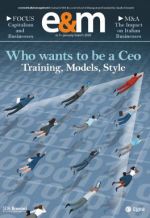
Being a Strategy Maker in the Digital Era
In the context of the broad digital transformation currently underway, CEOs must represent the engine of corporate change. In the role of the “strategy maker,” the CEO first of all has the role of defining how artificial intelligence can support strategic decisions at multiple levels, and secondly, to promote and guide the digital transformation. The CEO is also required to renew the strategies ...
Marchionne and Lessons in Leadership
In the three speeches he gave to the Bocconi community between 2012 and 2014, Sergio Marchionne spoke of himself as a “transformational leader,” i.e. a person who defines long-term values and inspires people by example to obtain results that go beyond the perimeter of formal contracts. Marchionne’s leadership is described through a long list of duties: to develop “optimism of the will” to ...
Are Top Managers Good Managers?
According to the “ Bravi Manager Bravi” study sponsored by Federmanager, the digital revolution is disrupting many of the business dynamics that have become consolidated over time. Managers are thus called on to govern that transformation and at the same time offer a vision for companies that becomes a collective narrative, so that the skills and potential of individuals can lead to repeat results ...
The Compass of Trust for Management
Customer trust is the main driver of the economic performance of a business. This is even more true in digital channels, the have a strong need for trust. To fully grasp the opportunities deriving from new technologies, it is necessary to move towards omnichannel marketing, that places the customer at the center of the business and its channels. This is the way to model the organization, the processes, ...
Family Business and New Leadership
In the period from 2012-2017, in Italy family-controlled and coalition businesses showed the largest increases in both operating and net profit, the best levels of liquid assets, and lower financial risk.Italian family-controlled and coalition businesses still show some criticalities, though: the gradual aging of leaders; the concentration of power through CEO duality; the distribution of power through ...
Conditions for the Growth of Italian Businesses
The structural difficulty preventing Italian companies from being able to grow, join forces and compete on the global market can be removed, both by intervening in the regulatory and fiscal context, and by imposing corporate governance choices that involve opening up capital to outside investors, private or otherwise, or opening up debt.The “necessary transition” that Italian companies must make ...
The Great Bet of Sustainability
The attention dedicated to issues linked to sustainability by the leaders of the largest multinationals has grown enormously in recent years, testifying to the weight these issues have taken on today at the highest levels of decision-making and corporate governance. Values, personal convictions, and vision, comprehension of global dynamics, the ability to involve the entire organization and the stakeholders; ...
The Present and Future of MBA Programs
The crisis that appears to have hit the MBA model in the English-speaking world can be explained by the concomitance of various factors: the increase of personal risk in investing time and resources, the strong competition from Masters of Science in International Management, online MBA programs, specialist masters, and the growing difficulties in finding success on the other side of the Atlantic.However, ...
Businesses Can No Longer Remain Neutral
In the new global scenario, functions and roles that were once the exclusive province of governments now come under the responsibility of businesses. Businesses must develop the ability to operate in increasingly broad contexts through a sort of corporate foreign policy, based on two elements: a reading of social and geopolitical issues, and forward-thinking corporate diplomacy with respect to issues ...
Italy-China Cooperation: Analysis of a Case of Stakeholder Management
Starting in 2015, in order to seize the opportunities coming from the international markets, grow in size, and achieve economies of scale, the management and shareholders of Pirelli decided that it was possible to allow the Chinese giant ChemChina to acquire a significant stake and exercise influence over the company's decisions.#The ChemChina-Pirelli case could represent a true benchmark for other ...